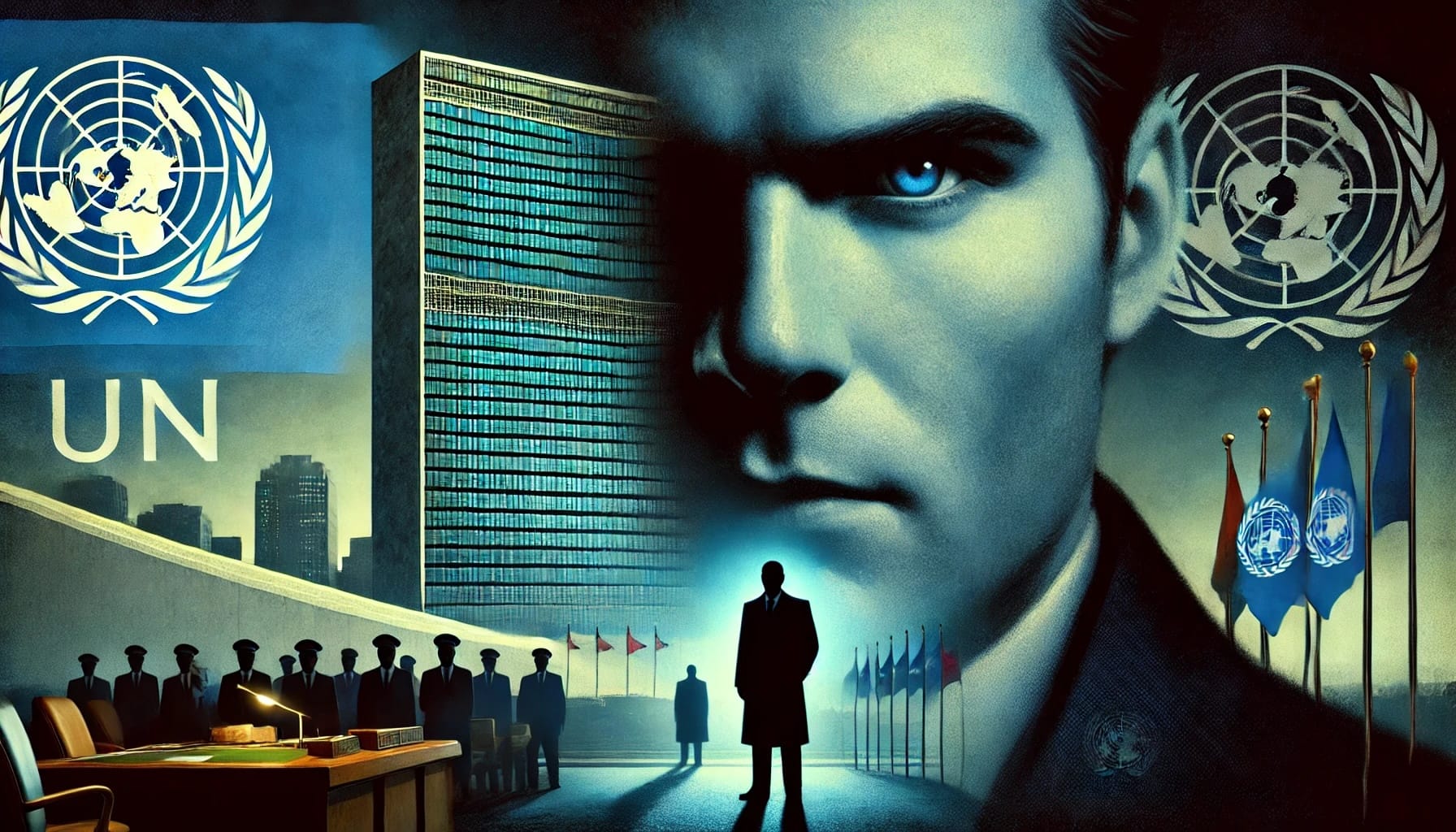
Chapter 1: The Least Offensive Man Alive
On the morning the United Nations nearly elected a fascist, the coffee machine on the thirty-eighth floor dispensed a thin beige liquid labeled ETHICS.
Lina Haddad stared at it for a moment, decided that this was either a joke, a prophecy, or grounds for an audit, and pressed the button for espresso instead. The machine hissed like a small offended snake. What emerged was black, bitter, and so hot it could have briefed the Security Council.
Outside the temporary offices for the secretary-general candidate dialogues, the corridor buzzed with that particular UN species of emergency in which nobody ran, everybody frowned, and a dozen people simultaneously said “just for situational awareness.” Young political officers in dark suits speed-walked past carrying folders that looked important and were, statistically speaking, full of adjectives. NGO observers queued with tote bags and missionary facial expressions. A TV crew was arguing with a protocol officer about sightlines in six different accents.
Lina took her cup and her badge and stepped back into the room she had been borrowing from Conference Services for three days. It had no windows, bad carpet, and four long tables covered in candidate binders, public CVs, mission statements, translated biographies, and the kind of official stationery that always made her feel the world was being managed by a very anxious stationery shop.
She preferred the archives.
The dead, in her experience, had many defects, but they interrupted less.
“Tell me again why Records has been dragooned into this circus,” said Malika from the far end of the table. Malika wore half-moon glasses, excellent lipstick, and the expression of a woman who had once believed in institutions and now mainly believed in lunch.
“Continuity support,” Lina said.
“That is not an explanation. That is a departmental weather pattern.”
Lina sat, opened the binder marked VOSS, ADRIAN, and flipped to the biography page she had already read three times that morning. Adrian Voss of Austria. Former foreign minister. Former special envoy. Former head of a foundation with an excellent logo and uncertain purpose. Fluent in German, English, French, and the polished moral fog of high office.
He was sixty-three, silver at the temples, handsome in the discreet way that made diplomats call a man “distinguished” when they meant “camera-safe.” He was, according to three different profiles, “calm,” “steady,” “pragmatic,” and “acceptable across regional groupings,” which in UN language was nearly erotic.
More importantly, he was nobody’s first choice.
That made him lethal.
The public story was that the selection process had become more open. There were dialogues now, webcasts, vision statements, earnest questions about climate and gender parity and artificial intelligence. The less public story was that five governments still had the power to smother a candidacy in its crib, and all five preferred a secretary-general who could be mistaken for upholstered furniture.
Adrian Voss was the best-upholstered man alive.
Lina turned the page. Education. Early service. Brussels. Vienna. Geneva. Then a line that had annoyed her at first sight and gone on annoying her all night.
1994–1995: Regional Stabilization Liaison, Special Assignment
No location. No institution. No direct superior. No useful nouns at all.
She circled it with a pencil.
Malika noticed. “Still bothering you?”
“It’s a hole,” Lina said.
“It’s diplomacy. Holes are where the air gets in.”
“Confidential assignments usually at least mention a city.”
“Maybe the city was confidential.”
Lina gave her a look.
Malika shrugged. “Ask him during the dialogue.”
“Excellent plan. ‘Mr. Voss, before we discuss sustainable financing, were you perhaps anywhere unsustainable in the mid-nineties under another name?’”
“That,” Malika said, “would at least improve the webcast.”
There was a knock at the door and a young staffer poked his head in. “Five minutes,” he said. “Also, press access has been widened.”
“Why?” Malika asked.
He blinked. “Transparency?”
Lina and Malika looked at each other.
“God help us,” Malika said.
The General Assembly Hall had the theatrical dignity of a place that knew history watched it and resented the overtime. Delegates settled into their seats beneath the great gold wall, each one framed by a little rectangle of national interest. Translators moved behind glass. Journalists arranged themselves in the press section like scavenger birds with credentials. The candidates sat below the podium in a line of carefully laundered ambition.
Lina took her assigned seat off to one side with the support staff, close enough to see facial expressions and far enough to be forgotten.
Adrian Voss entered without flourish, which in itself was a flourish. He moved with the tranquil confidence of a man who had spent his life walking into rooms where other people hoped to impress him. His suit was dark blue. His tie looked as though it had been ironed by a central bank. He smiled at the moderator, at the Assembly, at the translators’ booth, at the room as a whole. Not warmly. Competently.
A murmur rippled through the hall, small and involuntary.
It happened when a room full of adults encountered a person who had clearly been focus-grouped by destiny.
Two candidates went before him. One was brilliant and doomed. Another was passionate and therefore more doomed. Then the moderator announced Voss.
He rose, buttoned his jacket, and began.
“Excellencies, distinguished delegates, colleagues, and representatives of civil society. The United Nations does not suffer today from a lack of ideals. It suffers from a crisis of confidence in execution.”
Lina made a face.
Malika, two seats away, mouthed, of course he does.
Voss spoke for nine minutes without leaving fingerprints. He praised transparency, accountability, inclusion, women’s leadership, youth participation, institutional trust, climate resilience, development architecture, digital ethics, preventative diplomacy, and “the moral seriousness of patient administration.”
That phrase made Lina look up.
Patient administration.
It was a ridiculous thing to say with a straight face. Also faintly menacing, like being threatened by upholstery.
Then came questions.
A delegate from Costa Rica asked about Security Council reform. Voss answered with admiration for the aspirations of member states and respect for political realities, which was to say nothing at a level of craftsmanship that deserved carpentry awards.
A civil society representative asked how he would protect displaced populations.
Here Voss folded his hands and leaned slightly forward.
“We must reject both cruelty and chaos,” he said. “Human dignity depends on order. Communities that cannot absorb unlimited shock must not be treated as morally defective for saying so. The Organization must help states manage migration humanely, preserve social cohesion, and prevent destabilizing demographic panic.”
Something flickered in the booth above him.
One of the interpreters had stopped moving.
Not for long. Half a beat. Barely anything. But Lina saw it. She looked up and caught a woman in headset and dark jacket touching one earpiece with two fingers, as if she had suddenly heard an old song in the wrong century.
The interpreter recovered and continued.
Lina wrote down the phrase: destabilizing demographic panic.
A journalist in the press section also looked up sharply. He was broad-shouldered, slightly rumpled, and handsome in the damaged way of expensive things dropped down stairs. Lina recognized him after a second.
Felix Rowe.
Once a serious reporter. Then a scandal. Then a long public skid involving a bad book, a worse divorce, and one televised appearance so drunk it had briefly united three continents in pity.
He was listening now with the concentration of a man who had just smelled smoke.
The questions continued.
A student asked Voss what moral courage meant in office.
He smiled.
“Moral courage,” he said, “is resisting the temptation to confuse confession with governance.”
There it was again. Smooth, elegant, faintly off. A line that sounded wise until you rolled it in your mouth and hit bone.
Lina wrote it down too.
By the time the dialogue ended, the hall was full of the exhausted applause people used when they were unsure whether they had just witnessed substance or upholstery with subtitles.
The reception afterward occupied one of the glass-walled conference foyers overlooking the East River. New York glittered outside in a way that made diplomats more lyrical and budgets less real. Inside, waiters in black moved through clusters of ambassadors, aides, journalists, and NGO campaigners carrying trays of sparkling water, white wine, smoked trout, and small architectural canapés whose shape suggested a designer had been given notes by a peace process.
Lina took a flute of something dry and stayed near the edge. Receptions were fieldwork for anthropologists and punishment for archivists.
Felix Rowe was already circulating, looking simultaneously disreputable and invited, which was his chief professional talent. Voss stood in the center of one orbit, speaking to two ambassadors and a woman from a Scandinavian think tank with the perfect attentiveness of a man who made everyone feel heard and nobody feel specific.
“Excuse me,” said a voice at Lina’s elbow.
The speaker was a small elderly woman with sharp cheekbones, a tribunal badge on a blue ribbon, and a gaze that did not so much meet your eyes as invoice them.
“You’re Archives,” she said, looking at Lina’s badge.
“Records and information management,” Lina said. “Which is how the institution says archives when it wants to sound like software.”
The woman ignored the joke. “Do you handle transferred material from the Residual Mechanism?”
Lina blinked. “Some of it. Why?”
The woman glanced across the room at Adrian Voss.
“That man,” she said evenly, “is a Nazi.”
Lina stared at her.
Around them, a Ghanaian diplomat was laughing politely at a joke about working groups. Someone somewhere broke into French. A waiter rotated past with cheese.
“I’m sorry,” Lina said.
The woman did not lower her voice.
“I said that man is a Nazi.”
Two people nearby turned their heads, then pretended not to.
Lina set down her glass before she dropped it. “That is a very large allegation to make over smoked fish.”
“It is also the right venue. Men like him live off canapés.”
“Do I know you?”
“Dr. Esma Kovač. Former court translator. Sarajevo first, The Hague after. Now consultant, which means they ask me difficult things after they’ve made expensive mistakes.”
Lina knew the name. Not personally, but from metadata, acknowledgments, oral history projects. Kovač had translated testimony in half the Balkan cases that still made civil servants go pale.
Lina looked back at Voss. He was smiling at an ambassador from Brazil as if he had personally invented reasonable optimism.
“Why are you saying this to me?” Lina asked.
“Because you work with records, and records still have a chance if they meet the right person early.”
“You think he’s a neo-Nazi?”
Kovač’s mouth tightened.
“Don’t launder it with the prefix.”
Lina felt a chill that had nothing to do with the air conditioning.
Kovač went on. “He used a phrase in there just now. About social cohesion and demographic panic. He did not invent it. Men around him used language like that when villages were being emptied with clipboards. Later they all said they were only advising on logistics.”
“You’re sure it’s him?”
“I am old, not decorative.”
“That’s not what I meant.”
“I know exactly what you meant.” Kovač took a folded card from her sleeve, not her bag, and slipped it into Lina’s hand. “Look up this transfer reference. Audio and movement logs. If it still exists.”
Lina looked down. In small square handwriting, the card read:
RM-4E / Box 17 / Audio K-91 / VOS
She looked up again, but Kovač was already turning away.
“Wait,” Lina said. “If this is real, why not go to the press? Why not go public?”
Kovač stopped, half-turned, and let her eyes travel briefly to Felix Rowe across the room.
“Because public is where truth goes to get dressed badly,” she said. “First you authenticate. Then you embarrass.”
And then she was gone into the crowd, moving faster than seemed compatible with age.
Lina stood very still.
Across the room, Voss glanced toward her for the first time all evening.
Not at her, exactly. At the room. But his eyes crossed hers just long enough to register a person, a badge, a face. Then he smiled at someone else.
Felix Rowe appeared at her shoulder like a tabloid ghost.
“That looked cheerful,” he said. “Who was the war heroine?”
“Not now.”
“Was that Dr. Esma Kovač?”
“No.”
“That was definitely Dr. Esma Kovač.”
Lina slid the card into her sleeve. “You should hydrate.”
Felix grinned. “That is not a denial.”
“Neither is this,” Lina said, and walked away.
An hour later she was in the basement.
The public parts of the United Nations loved marble, flags, and phrases about humanity. The lower levels were where the building admitted it had organs. Fluorescent corridors. Locked doors. humming vents. Pallets. carts. shelving. The hidden empire of paper, cable, tape, and the boxes into which nations eventually became evidence.
Lina badged through three doors, signed two access logs, and entered the climate-controlled storage room that held part of the transferred tribunal material not yet fully processed into digital finding aids. Cold air hit her face. Rows of gray shelving stretched ahead in lit aisles, each shelf tagged in a handwriting she knew better than some relatives.
She found the 4E section.
Then the sub-series.
Then Box 17.
Or rather, the place where Box 17 should have been.
There was an empty rectangle on the shelf, cleaner than the metal around it.
For a moment Lina simply looked at the absence, which is what archivists do when reality turns theatrical.
Then she crouched and checked the movement card clipped to the shelf.
It had been removed for consultation three days earlier.
Requesting office: Strategic Transition Support Unit.
Authorized by: J. Marchand.
Lina read the name twice.
Julien Marchand was Adrian Voss’s transition adviser, the elegant Frenchman who had spent the last week gliding through candidate events with the expression of a man mentally improving the wallpaper.
Three days earlier.
Before tonight’s accusation. Before Voss’s final dialogue. Before most of the building had even decided he would win.
Lina straightened slowly, the cold room suddenly not cold enough.
Someone had gone looking for Box 17 before Adrian Voss became secretary-general.
Which meant one of two things.
Either Dr. Esma Kovač was wrong, and Adrian Voss’s people were blessed with a supernatural instinct for obscure Balkan tribunal material.
Or they were cleaning.
And people only cleaned that early when they already knew where the blood was.